When I talk to artists and crafters, I often get asked,
“How do you make a fabric collection?”
Today I want to share, from a designer’s point of view, the behind-the-scenes process of making a fabric collection.
Every designer, manufacturer, and industry is different.
My goal with this post is to share one perspective.
From coming up with an idea, to soon receiving finished bolts of fabric, this is my experience of making my new fabric collection,
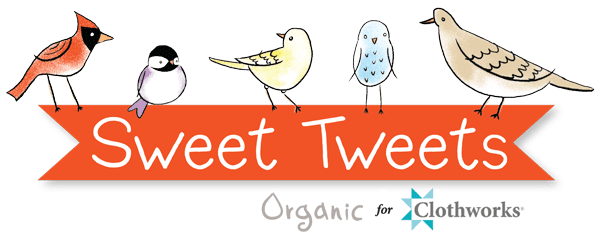
Sweet Tweets.
First off, let me give you some background.
Sweet Tweets is my fifth fabric collection designed for the quilting industry.
I license my designs to
Clothworks, a Seattle based manufacturer of premium quality quilt-weight cotton fabric sold to independent quilt shops all over the world.
Licensing means that I give Clothworks permission to use my designs on certain products, in a certain industry, for a certain period of time, over a certain location (territory), in exchange I receive a percentage of what’s sold (called a "royalty"). I get to keep the copyright and ownership of the designs.
Phew. There’s licensing in a nutshell for you.
The intended audience are quilters and crafters making items for baby. However, it’s important to me to include designs that can be used for other items not exclusively “baby.”
I like to think that my audience is people who want to “enjoy some cute.”
OK, now that we’re up to speed, let’s get to the process.
Beginning
Making Sweet Tweets did not start from “being inspired.”
I think a lot of people want to feel inspired before beginning a project. But sometimes you have to start a project, then inspiration will come after you’re already working on it.
It sounds backwards, but that’s the biggest advice I could give anyone who wants to be a working artist.
It’s pretty much my daily mantra.
Just start. Inspiration (and motivation) will come after.
Sweet Tweets began by having a deadline. And a deadline is a great excuse for getting started.
I had about 2 1/2 months to deliver final files to Clothworks so they in turn could get them to the factory to reach their own deadline.
Time to get started.
Inspiration
Usually I start a new collection with the content. (Basically, what cute animals do I want to draw.)
This time I thought I'd explore a style and color palette.
I’ve had an idea for a while to make a collection with a “drawn” look to it. Like little doodles. I thought that might be an interesting direction to go in.
For the color palette, I wanted to try a mostly black, white and grey collection with pops of colors. Like a coloring book being filled in with an 8-pack of crayons.
I wanted a collection that felt sophisticated yet still worked for “baby.”
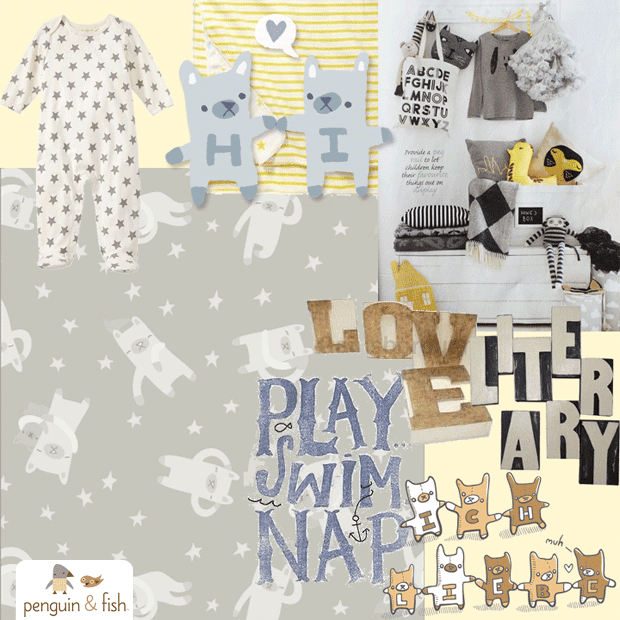
I proposed the “Animal Coloring Book” idea as well as a second unrelated concept, “Sleepy Bears,” to Clothworks.
Below are the initial concept boards. They're made with my sketches along with other art, patterns, and trends to give an overall feel of the collection.
Since I’ve worked with Clothworks before, and they know what to expect from me, quick concept boards were fine to get the ball rolling.
Usually at this point Clothworks will pick a direction. This time, however, the Clothworks team was split between the ideas, so they asked me to develop both a little more.
Theme
As I started to develop the animal coloring book idea, I realized that “doodles,” and “pops of color” weren’t enough to hold the collection together. I was having trouble figuring out what to draw with only “animals” as a guide.
I needed a theme.
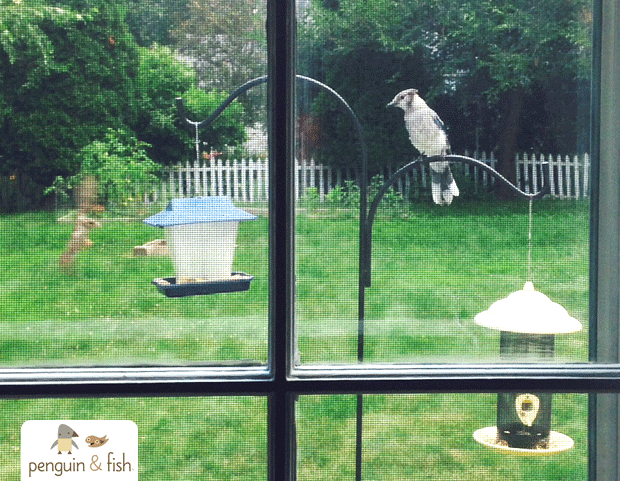
I have two bird feeders outside my studio window, and I love watching the flock of sparrows, the tiny chickadee, the family of cardinals, and the squawking bluejay come to eat. I call them my “outside pets.” I’ve been wanting to do a project that was inspired by them, and I thought maybe this collection was it.
So I got rid of the “lots of animals” idea, and decided to focus on one animal.
Birds.
Birds are also a popular animal in the “baby” and “quilting” markets, so the idea made sense.
With “birds” as the theme, all the designs could relate to birds in some way, making the whole collection more cohesive.
After deciding on a theme. Coming up with ideas immediately became easier.
Sketching
When designing anything, I start developing ideas in my sketchbook.
Always always always.
I make super rough drawings to get ideas down before I forget them. This process is much faster than doing anything on the computer.
After I had initial sketches and some ideas worked out, I switched to the computer.
I took a quick iPhone photo of the sketches then emailed them to myself (nothing fancy). Then I opened the sketches in Adobe Photoshop.
In Photoshop I started to trace the sketches, made new sketches, and honed them into actual drawings I liked. This meant cleaning up lines, drawing additional pieces, adjusting proportions, etc.
I draw in Photoshop with a pen and tablet made for illustrating on the computer.
I use a Yinova MSP19U tablet. It doesn’t have all the features that a Wacom Cintiq has, but it does the job for me right now.
I also started playing with the layout of the design. Are the elements close together? Are they in one direction or turned in all different directions (tossed)?
Typically each design has 3 different color versions (colorways). So I start to play with that as well.
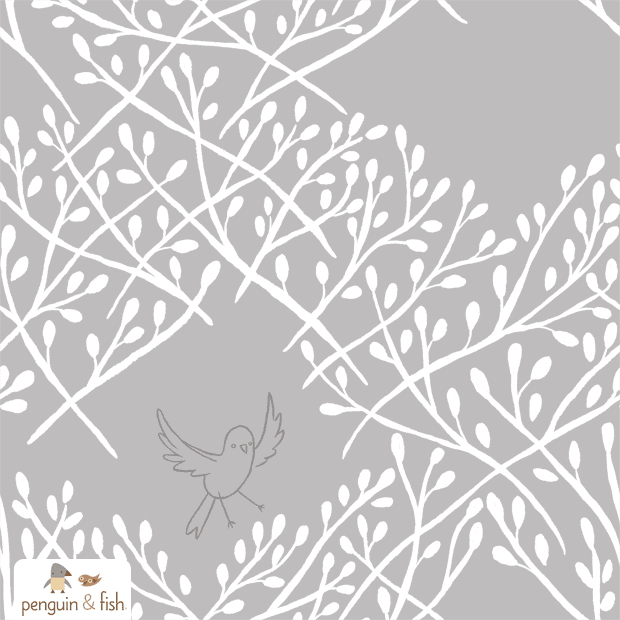
I worked on this “tossed bird” design in the above pic, made a couple other designs, then did the same process for the other proposed collection, “Sleepy Bears.”
At this point I had a good sense of how both collections would look, and was excited to work on either one.
Here are the revised ideas I sent to Clothworks.
Clothworks decided to go with the Bird collection.
Yay. Sweet Tweets was a go.
The next step was to continue to build the collection.
Building the collection
For the final collection I would need to have 6 different designs, each with 3 different colorways.
I continued sketching and developing designs, all the while asking myself the following questions:
• Will the designs appeal to my audience?
• Does each design stand on it’s own as well as within the collection?
• Do the colors work as a collection and in the individual designs?
• How well do the sizes of the elements in the designs relate to those in the other designs? Are any designs too big or small?
• How well will the size of the elements work on a sewn quilt block? On baby clothes?
• Do I have a good variety of “main theme” designs vs. “supporting” designs?
• How does the collection feel overall? Do I need to add a design to the collection to make it more fun? More sophisticated?
• Does the collection feel like me?
As I was building the collection I made a bunch of printouts (mostly black and white) so I could check sizes of elements and how one design works with another.
Having a printout gives me a more “physical” look at a design. It feels different than just looking on the computer monitor.
Repeats
I started to put the designs into repeat once I had a good idea of how a design would look.
I made the designs repeatable (connected each edge of the design so it seamlessly repeats) in Photoshop. I do this by duplicating an element on one edge of the design, then placing the copy along the opposite edge. Then I fill in the center area with other elements.
I have second large window open in Photoshop to test the repeat as I work on the designs.
I can see if I have mistakes in the repeat or if any spacing of the elements are weird. It’s also a chance to see if the overall feel of the design is what I was intending it to be.
At the factory, the printing screens that they use to print the designs to fabric are 24 inches wide. So all my designs have to be made to repeat at some multiple of 24 inches. So when they’re repeated on the screen, they end up at 24 inches.
So I can make my designs 24 inches wide, 12 inches, 8 inches, 6 inches, 4 inches, etc.
Finished designs
Once I had a finished collection that I was happy with, I sent it off to Clothworks again. If they had any changes at that point I'd go back and make them.
For Sweet Tweets they thought everything was good as is (yay), so it was time to prepare the files for the production process.
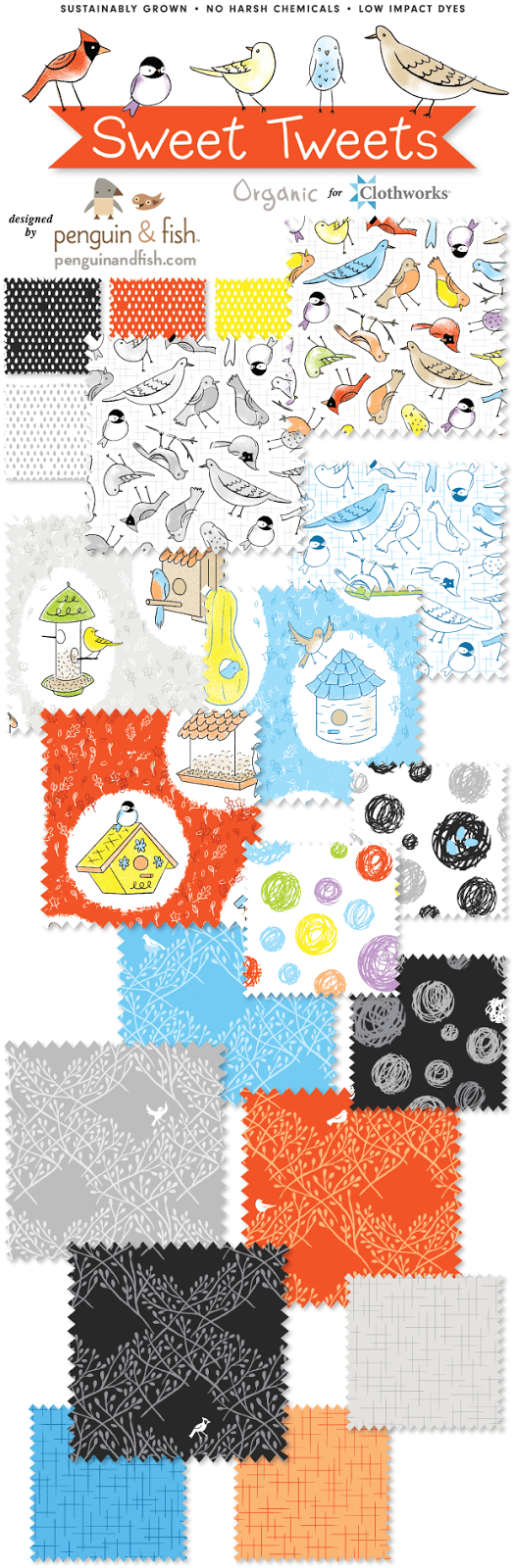
Here is the final Sweet Tweets collection.
Preparing designs for production
Preparing the designs for production was a 2 part process for me.
First I edited every Photoshop file so each color was on it’s own Photoshop layer. Those color layers also had to be in the same order as the other colorways of the same design.
This was a hugely tedious process but doing it right helps ensure that the design and it’s colors would be printed properly.
The second part of preparing the designs for production was to create something physical that the factory could match their ink colors too.
For me this involved printing out every design on my nice Epson printer and making any adjustments to the colors. The colors on my monitor are often not quite the same when printed.
Once the colors were how I liked them I made a new document that had numbered swatches of the colors. I also labeled the colors in the printed designs so that they corresponded with the numbers on my swatches printout.
That way Clothworks and the factory could easily see what colors go where and on what design.
Now everything was complete and I emailed (dropboxed) the files to Clothworks, and sent them the color print-outs in the mail. They in turn sent it off to the factory.
And that’s it!
The files are off to where they need to go.
Yay!
Now I wait.
For months.
Actually, I started working on ideas for the next collection after Sweet Tweets.
Strike offs
A couple of months after sending off the files, Clothworks let me know that strike offs arrived from the factory, and they would send them my way.
Strike offs are test prints on fabric from the factory.
Strike offs are used to see if there are any errors in the design or the colors before the factory prints yards and yards of fabric.
Clothworks and I compared the strike off colors to the colors in the original swatch and design print-outs that I sent to Clothworks.
If anything is wrong, like the red is too orange, or the blue is too dull, then it gets communicated to the factory and they make changes and send new strike offs. After everything is correct and approved, then the factory starts printing the actual fabric.
For Sweet Tweets, the strike offs were good (surprisingly) the first time around.
Woo hoo, let's get printing!
Waiting
After approving strike offs my part of the design process is complete.
Now I wait about 6 or 7 months before I see the final fabric.
During this time I designed embroidery and sewing patterns to sell through
Penguin & Fish that feature the collection. I also worked on marketing the new patterns and fabric, and prepared to market the collection at the International Quilt Market Trade show.
Below is the
Nest & Tweet quilt pattern that I designed to go with the collection, hanging in my trade show booth. It was made with the bits of strike offs that I received during the strike off stage. No real fabric yet.
The quilt was partially designed based on how much strike off fabric I had of each design.
Shipping
When the fabric is complete Clothworks will receive it from the factory on huge bolts or rolls.
Clothworks will do the final processing of the fabric, like rolling it onto smaller bolts of fabric. Then it will be ready to ship to stores.
We’re not quite at that point yet for Sweet Tweets, but it will be here soon in mid-October.
I haven’t seen it yet, and will get my hands on it the same time as everyone else.
Oh the suspense!
Interesting facts
To give you a sense of how long this entire process took, I sent my initial concept boards to Clothworks on September 20th, 2013. And the finished fabric will ship mid-October, 2014.
That’s over a year in the making.
During that time, I already completed the collection that comes after Sweet Tweets, and am currently working on the collection that follows that.
That’s 2 more collections before I even get to see the final Sweet Tweets fabric.
Pretty crazy.
But also really fun. I love that I have several collections going all at once. If I get burnt out on making marketing materials for one collection, I can jump to drawing designs for another collection.
Also I think it’s worth mentioning (especially for artists interested in designing fabric or licensing their designs), I don’t get any royalties until a month after the fabric starts shipping. So I won’t receive any payment for work done in September 2013, until November or December 2014.
There you have it.
My process of making a fabric collection from a designer’s point of view.
I’d love to hear your thoughts and any questions you have. Leave a comment below.
Are you a fabric designer? I’d love to hear a bit about your process. What’s the same? What’s different? Share your comments below.
Also be sure to check out the
Penguin & Fish website after October 5th to pre-order fabric bundles of Sweet Tweets.
If you'd like to place your order before then,
click here to sign up to my email list. All email subscribers will have first dibs in the Penguin & Fish fat quarter fabric bundle sale starting on October 1st. They will also be able to pre-order Sweet Tweets then.
UPDATE - The Penguin & Fish fat quarter fabric bundle sale is now over. Thanks so much to everyone who participated.
If you found this post interesting, I hope you join me to get my weekly emails on how to craft a happy life - and make something cute in the process. For signing up you’ll also get a FREE Picnic Pals minis hand embroidery pattern.
Click here to join (it's FREE too!)